The Real Cost of Scaling Cold Email Infrastructure
Per-seat and per-inbox pricing looks simple until you actually try to scale past a handful of mailboxes. Here's the real math behind three common pricing models.
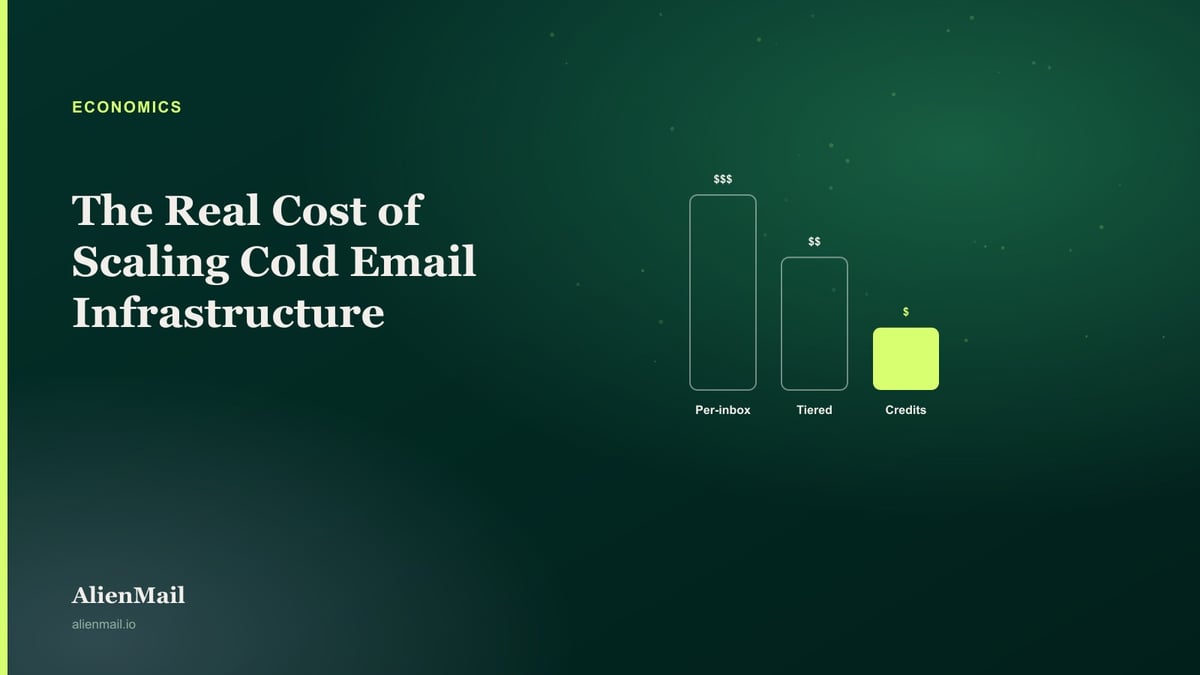

Most cold email platforms lead with a monthly price, but that number rarely reflects what scaling actually costs. The pricing model underneath — per-inbox, per-seat with inbox caps, or pay-per-credit — determines whether cost grows linearly, in steps, or barely at all as sending volume increases.
The three models
| Model | How it charges | Where cost comes from |
|---|---|---|
| Per-inbox | Flat fee per connected mailbox | Every inbox added is a direct, predictable cost increase |
| Tiered per-seat | Plan tiers with inbox caps (e.g., 50, 150, unlimited) | Cost jumps in steps when you cross a tier boundary, not smoothly |
| Pay-per-credit | Charged per email sent, inboxes unlimited | Cost tracks actual sending volume, not infrastructure size |
Worked example: scaling from 10 to 500 inboxes
Safe sending limits cap each inbox around 30-50 emails/day. To reach meaningful daily volume, inbox count has to scale with the target — this table shows how each pricing model responds as that scaling happens, using illustrative rates representative of the market (actual published pricing changes frequently and should be verified directly).
| Inboxes | Daily volume (~35/inbox) | Per-inbox model | Tiered model | Pay-per-credit model |
|---|---|---|---|---|
| 10 | ~350/day | Low, predictable | Fits in entry tier | Tracks actual sends only |
| 50 | ~1,750/day | 5x the 10-inbox cost | Likely crosses into next tier | Tracks actual sends only |
| 500 | ~17,500/day | 50x the 10-inbox cost | Requires top/enterprise tier or multiple accounts | Tracks actual sends only — no per-inbox penalty |
Where each model actually wins
Per-inbox pricing is transparent and easy to forecast at small scale, but it directly penalizes the exact behavior deliverability best practice requires — spreading volume across more inboxes at lower per-inbox send rates, rather than pushing fewer inboxes harder (which damages domain reputation faster, see our domain reputation guide). Every additional inbox added for safety is also an additional line item.
Tiered per-seat pricing softens this somewhat by bundling a cap of inboxes into a flat fee, but creates step-function cost jumps right at scaling boundaries — an agency at 145 inboxes on a 150-cap tier pays the same as one at 50, until they cross the line and jump to the next tier regardless of how few additional inboxes they actually need.
Pay-per-credit pricing decouples cost from inbox count entirely. Since the actual expense driver is emails sent, not mailboxes connected, adding inboxes purely for safe volume distribution — the deliverability best practice — costs nothing extra. This specifically rewards good sending discipline instead of taxing it.
The math for agencies specifically
Agencies managing outreach across multiple clients feel this most acutely, since inbox count scales with client count, not just campaign intensity. A per-inbox or capped-tier model means every new client onboarded requires either a plan upgrade or a new line-item cost, independent of how much that client is actually sending. A usage-based model ties cost to what's actually driving value — messages sent — rather than to how the infrastructure is organized behind the scenes.
What to actually check before committing
- Model the cost at your realistic 6-12 month inbox count, not your current one — tier boundaries and per-inbox multipliers compound faster than they look at small scale.
- Check whether warmup itself is billed separately or counted against your sending quota — some platforms charge warmup volume against the same credits as real outreach, which quietly inflates the effective cost per real send.
- Factor in whether the pricing model incentivizes or penalizes running more inboxes at lower volume each — the safer sending pattern.
Bottom line
The headline monthly price on a cold email platform tells you almost nothing about what scaling will actually cost. Model the pricing structure against your real inbox-count trajectory, and weight pricing models that don't penalize the safest sending pattern — more inboxes, lower volume each.
Your next campaign is six minutes away
Connect your business and let Alien AI handle the writing, structuring, and optimizing.
Generate my Business DNA — free