Monitoring Domain Health After Warmup Ends
Most deliverability content stops at the warmup phase. Reputation can still erode months into steady sending — here's what to check on an ongoing basis.
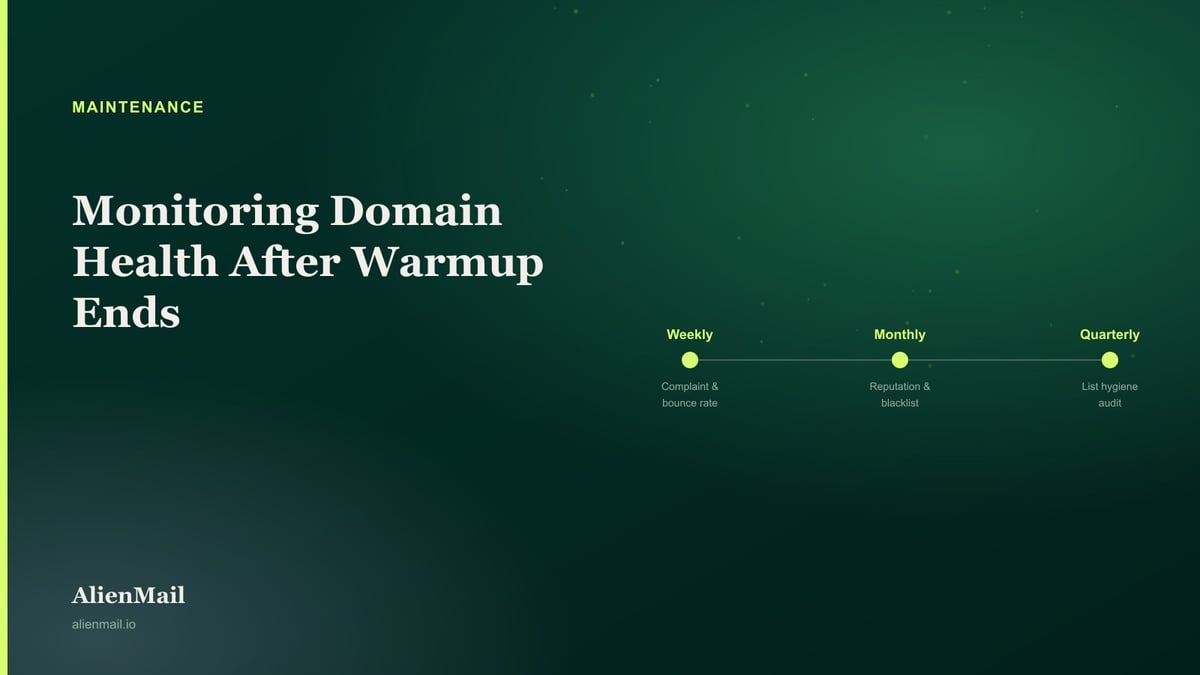

Most deliverability content — including the guides on this blog — focuses heavily on the warmup phase: the first 2-4 weeks before real sending starts. Far less gets written about what happens in month three or month six of steady sending, when reputation can still quietly erode without anyone noticing until reply rates have already dropped.
Why ongoing monitoring matters more than a one-time setup
Domain reputation isn't a score you earn once — mailbox providers recalculate it continuously based on recent behavior, weighted more heavily toward recent signals than historical ones. A domain that warmed up perfectly and sent cleanly for two months can still see reputation erode from list decay, a gradually rising complaint rate, or a new segment of the list behaving worse than earlier ones — all without any single dramatic trigger.
The ongoing monitoring checklist
| Frequency | Check | Tool |
|---|---|---|
| Weekly | Spam complaint rate trend | ESP/platform analytics, target under 0.3% |
| Weekly | Bounce rate trend | Sending platform — flag anything trending above 2% |
| Weekly | Reply rate trend by list segment | CRM/sending platform — a dropping trend by segment often precedes a domain-wide problem |
| Monthly | Domain/IP reputation | Google Postmaster Tools, Microsoft SNDS |
| Monthly | Blacklist status | MXToolbox — see our blacklist guide if anything shows up |
| Monthly | Authentication still resolving correctly | MXToolbox SPF/DKIM/DMARC check — DNS changes elsewhere can silently break these |
| Quarterly | List hygiene audit | Re-verify emails that haven't engaged in 90+ days; consider suppressing |
The specific pattern that catches people off guard
List decay is the quiet one. B2B contacts change jobs constantly — a list that was accurate six months ago has a meaningfully higher stale/invalid rate today, even with no change in sending practice. Rising bounce rate from natural list decay looks identical, in the moment, to a sending-practice problem, which leads teams to incorrectly suspect their content or domain when the actual fix is re-verifying and pruning the list.
What a declining trend actually means before it becomes a crisis
- Complaint rate creeping up over several weeks — usually a content or targeting mismatch developing gradually, not a single bad send. Review recent copy and list segments before it crosses the 0.3% threshold that triggers real placement problems.
- Bounce rate creeping up — almost always list decay. Re-verify and prune before it drags reputation down.
- Reply rate dropping with stable complaint/bounce rates — likely a content or offer fatigue issue, not a deliverability issue at all; don't reach for warmup or infrastructure fixes when the actual problem is the message.
- A sudden cliff in any metric — check blacklist status immediately; this pattern is the classic signature of a new blacklist listing.
Building this into a routine
None of these checks take long individually, but they only catch problems early if done on a schedule rather than reactively after reply rates have already dropped. A 15-minute weekly check and a 30-minute monthly check is a small time cost against the weeks it takes to recover a domain that's been quietly degrading unnoticed for two months.
Bottom line
Warmup gets a domain to a healthy starting reputation; it doesn't keep it there. Ongoing monitoring — weekly trend checks, monthly reputation and blacklist checks, quarterly list hygiene — catches the slow, quiet decline before it becomes the sudden collapse that's much harder to reverse.
Your next campaign is six minutes away
Connect your business and let Alien AI handle the writing, structuring, and optimizing.
Generate my Business DNA — free