7 Cold Email Templates That Get Replies (and Why They Work)
Seven short, proven cold email templates for B2B outreach, with notes on when to use each one and the mistakes that kill reply rates.

Good cold email templates are short, specific and built around one question. The seven below are frameworks, not scripts. Each one works because of its structure, not its exact words. Copy the structure, then rewrite every line for your buyer.
Before you use any template
A template can't fix a bad list or a broken setup. Check three things first:
Targeting. The best email to the wrong person still gets no reply.
Deliverability. If your email lands in spam, copy doesn't matter. Run our deliverability checklist before you launch.
Length. Aim for 50–125 words. Most people read cold email on their phone.
1. The problem-first template
Best for: buyers who already feel a known pain.
Hi {first_name},
Most {role}s at {company_type} companies I talk to spend hours each week on {painful_task}.
We help teams like {similar_customer} cut that to {result}.
Worth a quick look for {company}?
Why it works: it opens with their problem, not your product. The ask is a yes-or-no question, which is easy to answer.
2. The observation template
Best for: high-value accounts where you can research each person.
Hi {first_name},
Saw that {company} just {specific_trigger — opened a new office / posted 5 SDR roles / launched X}.
When teams do that, {common_problem} usually follows. We helped {similar_customer} avoid it by {how}.
Open to a 15-minute call next week?
Why it works: the first line proves the email isn't a blast. Trigger events also mean timing is right.
3. The social proof template
Best for: when you have a strong customer in the same niche.
Hi {first_name},
{Similar_customer} was dealing with {problem}. In {timeframe}, they {specific_result}.
I think {company} could see something similar. Want me to send over how they did it?
Why it works: buyers trust peers more than vendors. Offering to "send over" something is a lighter ask than a meeting.
4. The question-only template
Best for: starting a conversation in a crowded market.
Hi {first_name},
Quick question: how is {company} handling {specific_process} today?
Asking because we've been helping {role}s fix {problem} and I'm curious whether it's on your radar.
Why it works: there's no pitch to reject. People reply to questions about their own work.
5. The value-first template
Best for: when you have a useful resource, audit or teardown.
Hi {first_name},
I put together a short {audit / benchmark / checklist} on {topic} for {industry} teams.
One finding stood out: {specific_insight}.
Happy to send the full version. Want it?
Why it works: you give before you ask. A "want it?" reply also warms the thread for later sales talks.
6. The referral template
Best for: when you aren't sure who owns the problem.
Hi {first_name},
I'm trying to reach whoever handles {area} at {company}.
We help {company_type} teams {result}. Would that be you, or is there someone better to talk to?
Why it works: it's easy and polite to point you to a colleague. A referral from inside the company carries weight.
7. The breakup template
Best for: the last step in a sequence.
Hi {first_name},
I haven't heard back, so I'll assume {problem} isn't a priority right now.
If that changes, just reply to this email. I'll leave it here.
Why it works: it removes pressure. Many teams find the breakup email pulls a surprising share of a sequence's replies. Plan when it goes out using our follow-up sequence guide.
Which template should you use?
Situation | Template | Ask |
|---|---|---|
Clear, common pain | Problem-first | Yes/no interest |
Fresh trigger event | Observation | Short call |
Strong case study | Social proof | Send the story |
Crowded market | Question-only | Reply with an answer |
Useful asset ready | Value-first | Send the asset |
Unknown decision-maker | Referral | Point to the right person |
End of sequence | Breakup | Reply if things change |
Six rules that matter more than the template
One email, one ask. Two questions halve your replies.
Write like a person. No "I hope this email finds you well." Get to the point.
Personalize the first line, not every line. One real detail beats five merge tags.
Keep links out of the first email. Links and images can hurt inbox placement. Save them for later steps.
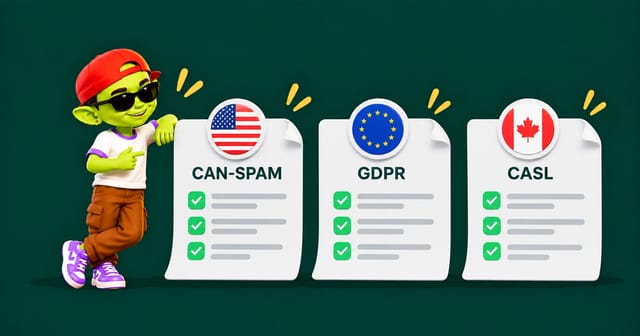
Include a way to opt out. In the US, the FTC's CAN-SPAM guide says commercial email needs a clear opt-out and a valid postal address. A plain line such as "Not relevant? Just let me know" works in cold email.
Test subject lines too. The best body won't be read if the subject fails. See our subject line guide.
Templates also go stale. If thousands of senders use the same wording, filters and buyers both learn it. Change your phrasing often. AlienMail's AI personalization can write a unique version of each email from your template and prospect data, so no two messages read the same.
Bottom line
A good cold email template is a structure: problem, proof, one small ask. Pick the one that fits your situation, rewrite it in your own voice, and keep it under 125 words. Then send it from warmed inboxes so it actually reaches the inbox. You can try the full workflow in our demo.
Related guides: what is a cold email, how to end a cold email, best AI cold email tools and cold email for startups.
Frequently asked questions
How long should a cold email be?
Aim for 50–125 words. Short emails are easier to read on a phone, and they leave less room for the reader to find a reason to say no.
Should I use the same template for every prospect?
Use the same structure, but change the first line and the proof point for each segment. Identical wording sent at scale tends to underperform and can hurt deliverability.
What is a good reply rate for cold email?
It depends on your market and list. Our cold email benchmarks break down typical reply rates by setup and targeting.
Should a cold email include a calendar link?
Not in the first email. Ask whether they're interested first. Share a calendar link once they reply.
More from the blog
Your next campaign is six minutes away
Connect your business and let Alien AI handle the writing, structuring, and optimizing.
Generate my Business DNA — free